

Weather routing extends beyond weather avoidance
For most people, the term weather routing is associated with helping vessels avoid extreme weather and adverse sea conditions, thereby mitigating the impact of weather on a ship’s voyage.
For weather routing operators, however, weather routing is not just about the weather. Behind every routing recommendation lies a series of operational decisions that extend far beyond the forecast.
In recent years, the operational environment has changed significantly, as the IMO has introduced new regulations requiring shipowners and charterers to comply with measures such as the Carbon Intensity Indicator (CII), EU ETS (EUA Allowances), and the expansion of Emission Control Areas (ECAs) along major shipping routes.
At the same time, it is essential to evaluate which operating speed (FULL, ECO or ULTRA ECO) results in the lowest overall voyage cost while still meeting the required ETA.
As a result, a weather routing operator must simultaneously consider weather forecasts, fuel consumption, regulatory requirements, emissions, operational costs and schedule constraints in order to provide the most efficient routing solution.
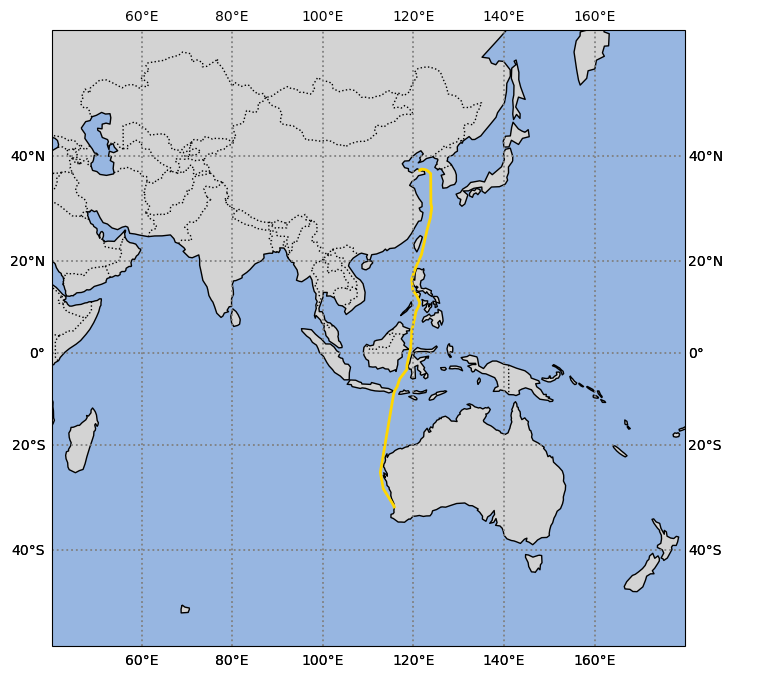
Below is a case study involving one of our vessels on a laden voyage from Yantai, China to Kwinana, Australia.
The vessel, a General Cargo Ship, was evaluated using two speed profiles:
FULL Speed : 13.1 Knots at 28.6 MT IFO/day + 0.1 MT LSMGO/day
ECO Speed: 11.6 knots at 20.6 MT IFO/day + 0.1 MT LSMGO/day
The agreed commercial assumptions between Owners and Charterers were:
• Hire: USD 18,000/day
• IFO: USD 900/MT
• LSMGO: USD 1,500/MT
Our weather routing team analyzed both operating scenarios and obtained the following results.
The voyage passes through the Chinese ECA, with ETA requirements that can be comfortably maintained and does not require any EUA Allowances (no European ports are included).

The estimated difference between the two operating speeds amounts to USD 32,130 in favor of the ECO Speed scenario.
However, cost is only one part of the analysis. It is equally important to evaluate the environmental performance of each scenario, particularly the resulting CO₂ emissions and the vessel’s CII rating.

In addition to the lower estimated voyage cost, operating at ECO Speed significantly reduces the vessel’s carbon footprint and improves its CII rating from D to B.
This case demonstrates that weather routing is much more than weather avoidance. By integrating meteorological data with operational, commercial and environmental considerations, weather routing becomes a valuable decision-support tool that enables ship operators to reduce costs, improve regulatory compliance and enhance the overall efficiency of every voyage.