

🌊 WEATHER ROUTING CASE STUDY | LONGER ROUTE. SHORTER VOYAGE.
A route does not have to be shorter to be more efficient.
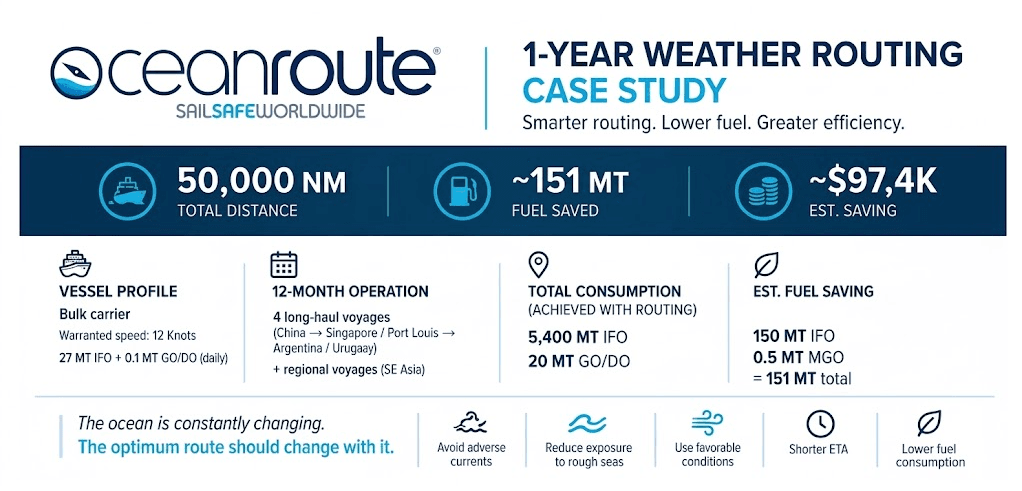
For a bulk carrier trading between Asia, the Indian Ocean and South America, we analyzed the vessel’s voyages over an annual operating profile of approximately:
📊 VESSEL & ANNUAL OPERATING PROFILE
• ~50,000 NM sailed for 1 year
• ~4,800 hours at sea
• 12.0 knots service speed
• 27 MT IFO/VLSFO + 0.1 MT MGO per day while sailing
• Long-haul voyages between China, Singapore, Port Louis and Argentina/Uruguay, together with regional trading in Asia
One representative voyage clearly demonstrates the impact of weather routing.
📍 PORT LOUIS → BUENOS AIRES
Without Weather Routing
5,878 NM | 527.9 hours
With Oceanroute Weather Routing
6,088 NM | 513.9 hours
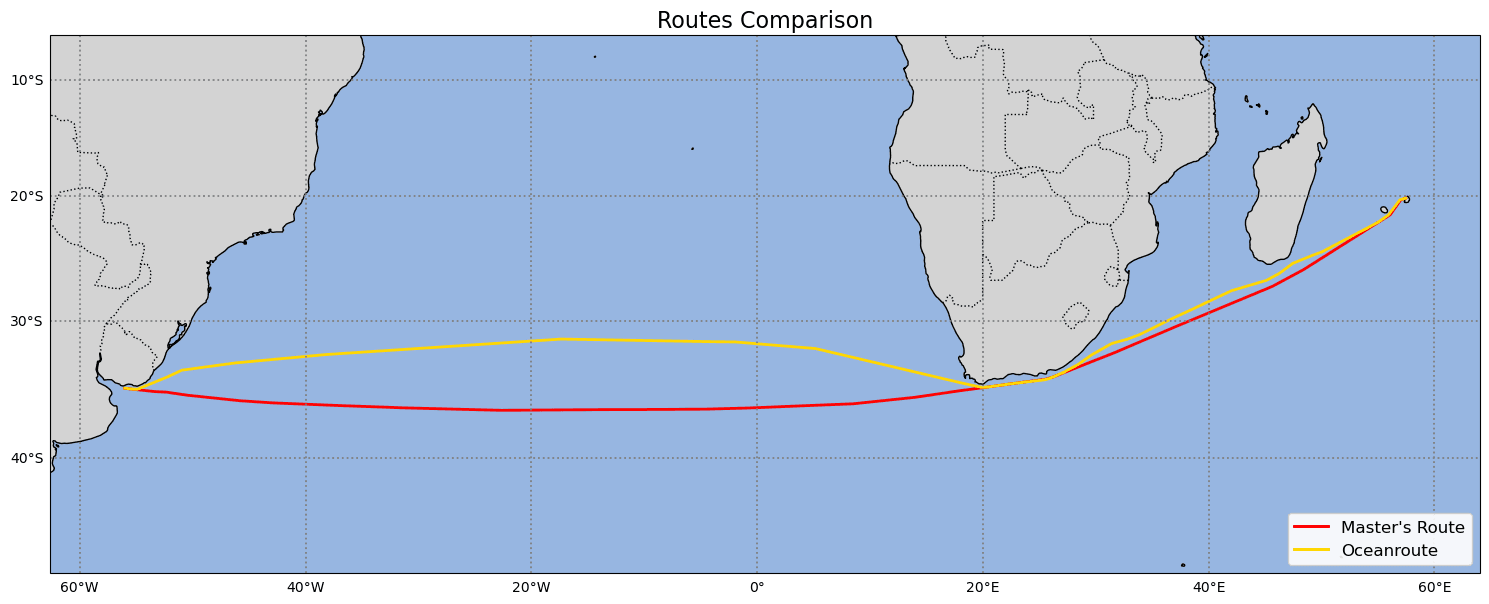
The Oceanroute route was approximately 210 NM longer, yet the vessel arrived 14 hours earlier — reducing sailing time by approximately 2.6%.
At the same time, the optimized route allowed the vessel to avoid rough weather and achieve measurable fuel savings:
⛽ VOYAGE FUEL SAVING
• 16 MT IFO
• 0.05 MT MGO
When this performance is considered against the vessel’s approximately 4,800 annual sailing hours in a year, the estimated annual fuel saving is:
📈 ANNUALIZED FUEL SAVING
• ~150 MT IFO
• ~0.5 MT MGO
🌊 WHY WEATHER ROUTING MATTERS
The shortest route on a chart is not necessarily the most efficient route at sea.
Weather routing continuously evaluates wind, waves, currents and sea state to identify opportunities to:
→ Avoid adverse currents
→ Reduce exposure to rough seas
→ Minimize the impact of unfavorable wind and waves
→ Take advantage of favorable weather and currents
→ Optimize ETA and fuel consumption
The result is not simply a different line on the chart.
It is better voyage performance.
💰 ECONOMIC IMPACT
Based on current indicative bunker prices, the annualized fuel saving represents approximately:
~USD 97,400 estimated annual fuel-cost saving
The route was longer.
The voyage was shorter.
The vessel consumed less fuel and rough weather was avoided.
Author: Dimitris Maragiannis / Weather routing operator